
Sorigin Recycling
Specialized in waste recycling machinery
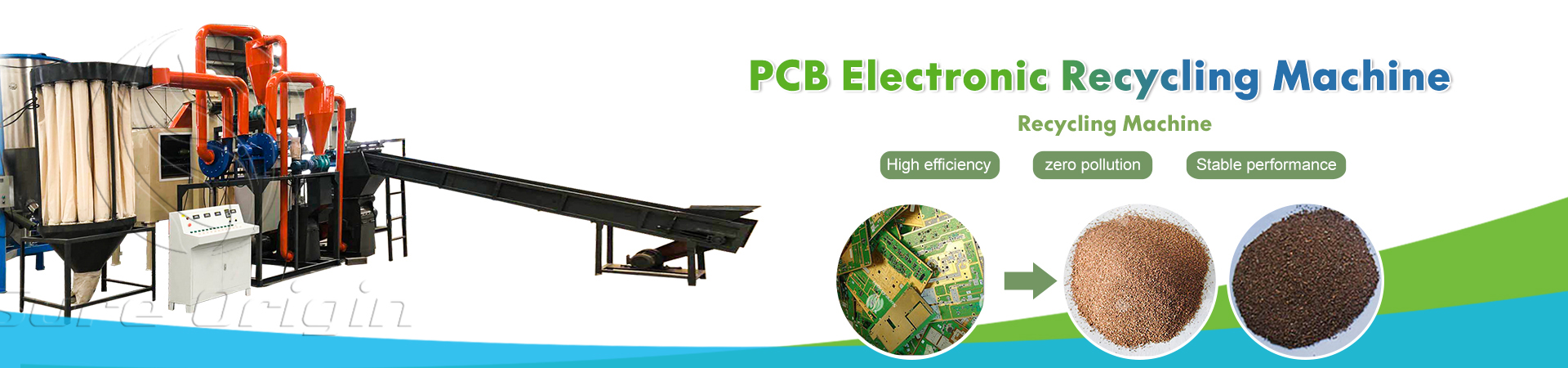

Solution for PCB Circuit Board Recycling in the UAE: Establishing a Sustainable Disassembly and Recovery Facility
The rapid growth of electronics consumption in the UAE has led to a surge in electronic waste (e-waste), particularly
printed circuit boards (PCBs), which contain valuable metals and hazardous materials. Establishing a specialized PCB
recycling facility in the UAE addresses both environmental risks and resource scarcity. This article outlines the types
of PCBs, the advanced processing workflow of separation equipment, final product purity, and the key challenges
resolved for clients.
1. Types of PCBs Processed
The UAE’s diverse electronics market generates PCBs from various sectors, necessitating a versatile recycling approach.
The facility handles:
By Circuit Layers: Single-sided, double-sided, multilayer, and high-density interconnect (HDI) boards (used in smartphones
and automotive sensors).
By Substrate Material: Rigid boards (computers, industrial controls), flexible boards (wearables), and metal-core boards
(LED lighting).
By Metal Content: High-grade boards (e.g., server PCBs with 40%+ metal content) and low-grade boards
(consumer electronics).
This classification ensures tailored processing for optimal recovery efficiency.
2. Advanced Separation Equipment Workflow
The facility employs a multi-stage dry physical separation process, combining mechanical and electrostatic techniques
to maximize yield and purity:
Step 1: Pre-Treatment & Size Reduction
Dual-Shaft Shredder: Breaks PCBs into 20mm strips.
Coarse Crusher: Reduces strips to ≤10mm particles.
Fine Grinding: Further pulverizes particles to 0.5–2mm, liberating metals from non-metals.
Step 2: Density-Based Separation
Airflow Classifier: Uses centrifugal force to separate heavier copper (density ~8.9 g/cm³) from lighter aluminum and resin
(density ~1.5–2.0 g/cm³).
Vibrating Screen: Removes oversized particles for reprocessing.
Step 3: High-Precision Electrostatic Separation
Triboelectric Separator: Charges particles via friction and separates them in an electric field. Metals (conductive) are attracted
to one electrode, while non-metals (insulative) migrate to the other.
Eddy Current Separator: Further refines non-ferrous metals (e.g., aluminum) from residual plastics.
Step 4: Dust Control & Emission Management
Pulse Dust Collector: Captures 99% of airborne particles (e.g., glass fiber, brominated flame retardants), ensuring complianc
e with UAE environmental standards.
3. Final Product Purity & Applications
The facility achieves industry-leading purity levels:
Metals: Copper (99.5% purity), gold (99.9% from electroplating residues), and aluminum (99.2%).
Non-Metals: Glass fiber-reinforced resin powder (≤0.5% metal contamination), repurposed as filler in:
Lipoplast Wood: A composite material for outdoor furniture, decking, and fencing.
Construction Aggregates: Used in lightweight concrete and insulation panels.
PRODUCT
- Mini Copper Wire Recycling Machine
- Scrap Copper Cable Wire Recycling Machine
- Scrap PCB Boards Recycling Machine
- PCB Dismantling Machine
- Aluminum Plastic Separation Machine
- Copper Aluminum Radiator Seprator
- Electrostatic Separator
- Eddy Current Separator
- Metal Crusher
- Air Gravity Separator
- Lithium-Ion Battery Recycling Plant
- Electromator Stator Seperator
Leave Message